Vladimir Putin in Tokyo for oil and territorial talks about Kuril islands and Finland`s occupied territories: Petsamo, Salla, Kuusamo, Karjala and island of Finnish Gulf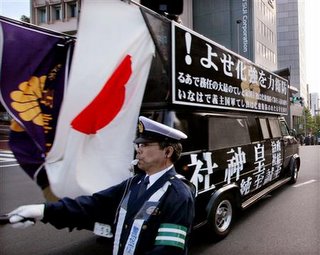
The Japanese ultra-nationalists' black van moves through streets near the Russian embassy in Tokyo November 20, 2005, blaring slogans through loud-speakers. REUTERS/Toshiyuki Aizawa
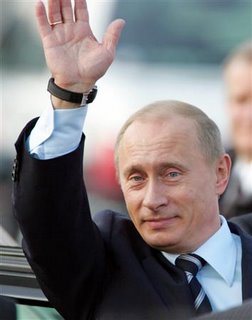
Russian parasite, hustler, pedofile rapist towards chesnyan children President warcriminal and occupier "baboondog" Vladimir Putin waves upon arrival at Haneda international airport in Tokyo November 20, 2005. Putin flew into Japan for a three-day official visit. REUTERS/Toshiyuki Aizawa
http://today.reuters.co.uk/news/newsarticle.aspx?type=worldNews&storyid=2005-11-20T083929Z_01_KWA020784_RTRUKOC_0_UK-JAPAN-PUTIN.xml
Putin in Tokyo for oil and territorial talksSun Nov 20, 2005 8:39 AM GMT17
By
Maria GolovninaTOKYO (Reuters) - Russian President Vladimir Putin arrived in Tokyo on Sunday for three days of tense diplomacy aimed at putting aside a 60-year territorial row between the Pacific neighbours and opening the door for more trade.
His arrival was met with loud protests from Japanese ultra-nationalists, demanding the return of four Pacific islands seized by the Soviet army in the closing days of World War Two.
The dispute over the tiny wind-swept islands, known as the Northern Territories in Japan and the Southern Kuriles in Russia, has marred relations between Tokyo and Moscow for much of the 20th century and has prevented them from signing a peace treaty.
Dozens of buses with loudspeakers blaring messages such as "Return the Northern Territories" and "Go home" attempted to park outside the central hotel where Putin was staying, but were kept back by a police cordon.
Some protesters carrying Japanese flags and banners briefly clashed with police as they tried to climb over the barriers. Police appeared to take several people into custody before the demonstrators were dispersed.
Putin, travelling from South Korea where he attended the APEC summit was due to visit a Russian exhibition later in the day. He last visited Japan in 2000.
On Monday, the Kremlin leader, accompanied by more than 100 top Russian businessmen, was due to attend an economic forum and meet Japanese Prime Minister Junichiro Koizumi.
150TH ANNIVERSARY
Moscow and Tokyo want to put economic incentives above politics and use the symbolism of this year's 150th anniversary of their first trade treaty to open up more trade between the world's No. 2 economy and the world's No. 2 oil exporter.
Current trade turnover between them is about $10 billion (5.8 billion pounds), a tiny proportion of Japan's trade with China or the United States.
Officials said that a lack of progress on the islands issue was likely to prevent Putin and Koizumi from signing a key "political declaration" emphasising their intention to intensify work to break the territorial deadlock.
"Given our different positions over the territorial issue, at the moment, it looks extremely difficult for us to come up with a new document," said a Japanese foreign ministry official.
While avoiding the islands issue, Putin and Koizumi will try to focus on economic ties. Japan will try to coax guarantees from Russia to build its huge oil pipeline to the Pacific rather than to China. Under Tokyo's ideal scenario, the pipeline would put up to 1.6 million barrels a day to a port close to Japan.
Although Putin will try to avoid a clear answer on the pipeline issue, he will try to squeeze money out of Japanese investors to develop Russia's resources-rich but poor Eastern Siberian regions.
"Economy and trade matters have to push politics forward, not the other way around," a Kremlin official told Reuters.
They will also discuss projects in Russia's Sakhalin island, as well as cooperation between the world's No 1 gas company, Gazprom, and Japanese firms in natural gas projects.
Russia and Japan have stubbornly refused to budge from their long-held positions on the islands, with Japan saying it won't sign a peace treaty unless they are returned.
Russia has offered to hand over two of the islands but Japan firmly rejected the proposal which was based on the 1956 Japan-Soviet declaration.
Despite rising tensions in the highest echelons of diplomacy, people on the streets of Tokyo seemed more indifferent.
"We think the islands are ours. Russia thinks they are part of Russia. Well, what can I say, it's just a very unfortunate arrangement," Minako, an office worker, said on a central Tokyo street festooned with flapping Russian and Japanese flags.
(Additional reporting by George Nishiyama)
-----------------------------------------------
Kommersantin mielipidekirjoituksessa ounastellaan, että saarten palautuksessa voi mennä hyvin vielä 50 tai 100 vuotta, ja että Putinilla ei ole mitään hävittävää, mutta toisaalta paljon voitettavaa.
Can Russia and Japan talk about anything else besides the Kurile Islands? The real price of Russian President Vladimir Putin's visit to Tokyo, the first in five years, will depend a lot on the answer to that question. Negotiations over the islands and a peace treaty have withered away like an old fig tree in an orchard of orange trees, in spite of the best diplomatic efforts. The difference in the president's visit is that it is the first acknowledgment of the failure of those talks, even if no one is saying so out loud. If the Russian-Japanese summit only reinforces that unhappy but unavoidable ritual, the price will be expressed with an unambiguous minus sign.
But even if there is no peace treaty between Russia and Japan for a long time to come, which would be unnatural, the minus sign can still be transformed. For that, everything depends on how much the Russians can distract Japan from that unsolvable problem and make Japan understand how much Russia can give (as well as not give). It would be not bad for the Russians to understand as well what Russia can give to Japan, just as it made that clear to China once.
Until recently, Russia did not pay much attention to why it needed Japan. For a long time, Russia regarded Japan almost as its complete opposite and was convinced that nothing would work out between the two countries in any case. A well-known Russian comedian did not by chance visit that country and recount with pleasure how vast the differences are – Japanese women serve the men at the table and drink their sake warm and what is a mountain for the Russian is a pit for the Japanese.
In diplomacy, the mountain is still not coming to Mohammed (but he is on his way to it) and economically the mountain is already a pit. With all the discussion of the islands, the fact has receded into the background that Putin is bringing more than 100 Russian businessmen with him, including leading representatives of the energy, metals, telecommunications, transportation and banking sectors. Tokyo has never seen such an influx of Russian businessmen. That is a sure sign that relations are not all that hopeless. The Eastern Siberian oil that could flow bathe the Land of the Rising Sun is a strong argument for leaving the issue of the islands lie for another 10, if not 50, years, or even better for 100. But when all the oil is gone, and that day will come, the issue will come up again.
Putin has nothing to lose and a lot to win if he can tell the Japanese that the discussion can be continued in a century.
by Sergey Strokan
http://www.kommersant.com/page.asp?idr=520&id=62709 ( linkki ei toimi )
Russian Article as of Nov. 17, 2005
-------------------------------------
 Junichiro Koizumi
/ Image by MosNews
Russia, Japan Should Set Aside Dispute Over Islands — Koizumi
http://www.mosnews.com/news/2005/11/17/japandispute.shtmlCreated: 17.11.2005 15:24 MSK (GMT +3), Updated: 15:24 MSK
MosNews
Japanese Prime Minister Junichiro Koizumi urged Russia Thursday to set aside the discussion of a long-running territorial dispute between the two countries for the time being.
“We should think twice whether it is worth focusing on this issue at present,” Koizumi told a news conference in Tokyo.
“The sides will hardly reach an agreement on this complex issue, which has existed for 60 years,” he was quoted by RIA Novosti as saying ahead of Russian President Vladimir Putin’s Nov. 20-22 visit to Tokyo.
He said that the territorial dispute, which involves four islands off Russia’s far-eastern coast, was a complex problem and both sides had different approaches toward its resolution.
“It will take time and further discussions [to resolve it],” the Japanese leader said.
On Nov. 13, Koizumi told Russian television that both countries could develop relations despite the territorial disagreement.
Relations between the two countries have been strained in recent years due to the dispute over the Kuril Islands. Japan claims sovereignty over four islands that became part of the Soviet Union after World War II. The issue remains unresolved and has prevented the signing of a peace treaty to end the state of war between the two countries formally.
------------------------

A view of the Kurile Islands’ volcanic arc / Photo from volcano.und.nodak.edu
Indigenous Groups Say Neither Japan Nor Russia Can Claim Kuriles
Created: 15.11.2005 09:42 MSK (GMT +3), Updated: 10:40 MSK
Mosow News
Groups of Ainu, the indigenous people of Hokkaido, and civic groups delivered a joint statement to the Japanese Foreign Ministry and Russian Embassy in Tokyo on Monday, saying neither Japan nor Russia has the right to claim the disputed northern islands as they belong to the Ainu people, Kyodo News reported.
The opinions of the Ainu people must be taken into account when the two countries negotiate over the four islands off Hokkaido, the statement said, adding the Ainu had initially inhabited these islands, known in Japan as the Northern Territories and in Russia as the Southern Kuriles.
In an interview aired Sunday on Russian television, a week ahead of Vladimir Putin’s planned visit to Tokyo, Japanese Prime Minister Junichiro Koizumi reiterated his hope the long-standing dispute would soon be resolved.
Resolving a 60-year-old row over four disputed Pacific islands would significantly boost ties between Japan and Russia, Koizumi said.
But the Japanese leader noted that a resolution on the four southernmost Kuriles islands was not a precondition for improving bilateral relations. “I am not saying that we should not develop bilateral relations before the territorial problem is sorted out,” Koizumi told Rossia, Russia’s second public television channel.
He added that resolving the row over the four islands — the Kuril chain separates the Sea of Okhotsk from the North Pacific Ocean and lie between Russia’s Kamchatka peninsula and the Japanese island of Hokkaido — would “open the way to a tremendous strengthening of relations.”
“In principle, I am optimistic, but not to the extent of hoping to solve this question during a single meeting.
”Obviously, one would like this meeting (with Putin) to allow things to move forward a step or two,“ he added.
Extensive negotiations between Moscow and Tokyo since the fall of the Soviet Union in 1991 have failed to resolve the Kuriles dispute, the AFP news agency reported.
The Soviet army seized the islands after Japan’s capitulation in World War II and the dispute has prevented Russia and Japan signing a peace treaty formally ending hostilities. Earlier this year, Putin had to scrap plans for a visit to Tokyo after a diplomatic dispute between the two sides. Russia offered to hand over two of the islands but Japan insisted on all four islands in return for a promise not to expel Russian inhabitants.
http://www.mosnews.com/news/2005/11/15/ainukuriles.shtmlhttp://wwnet.fi/users/veijone/cover14.gif


 Posts


